|
Balanced Organization: 5 Basic Elements
Empowered
Employees (Metal):
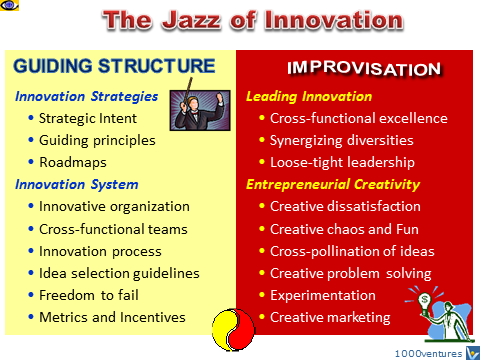
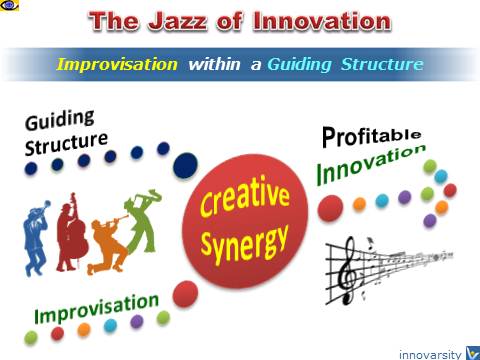
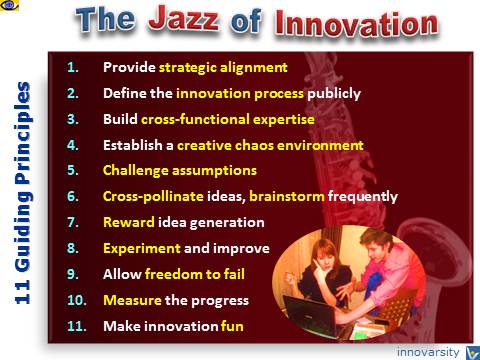
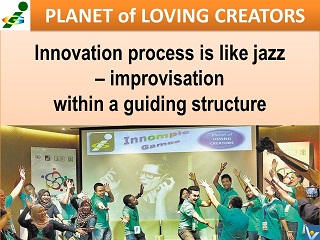
The Jazz of Innovation
To jazz up your ability to innovate, turn to
jazz.
The improvisation-driven model for
innovation project
management doesn’t discard structure, just as there
is a clear structure to good jazz.
In innovation, this structure is created
through
roadmaps, guiding principles,
business processes, systems and organizational
charts.
Strategic-planning
and road-mapping processes cannot guarantee brilliant flashes of creative
insight, but they can prepare minds and increase the odds that such flashes
occur in real time. Thus structure, as chords do in jazz, serves as a basis
for improvisation,
experimentations,
discoveries and
innovation.
Leadership-Management
Synergy
Leaders: Lead improvisation.
Managers: Provide structure.
► Resulting synergy: Jazz
of innovation...
More
Finding the Right
Balance
Between Structure and Chaos
You need a certain amount of
chaos to be creative but not to the point that
you feel overwhelmed by its amount. Too
much uncertainty discourages people from mobilizing their best effort.
Direction and purpose and a
certain amount of structure create freedom. People feel liberated by goals and guidelines.
29 Obstacles To Innovation
Creating a Culture for Innovation
Creating new strategic initiatives around organizational design and
structure,
innovation processes,
innovation metrics, and other
levers can make a significant difference in
shaping the culture, and
there are many practical approaches for manipulating each lever....
More
10 Roles of an
Inspirational Leader
-
Encourage risk taking.
Take risks. Don't play it safe. Making mistakes is essential to
innovation and organizational growth, as long as systems are
developed to learn from failures and to avoid making the same
mistake twice. The more people fail, the more they succeed. They
learn from
taking action, from mistakes, from
feedback, from getting going. Treat failures as learning
opportunities. Develop a tolerance for mistakes and give your people
freedom to fail, learn from failures, and start again more
intelligently...
More
10 Ways To Murder Creativity
The Way Our Mind Works
Our
brain is divided into two hemispheres, the left and the right, and each
hemisphere specializes in different functions,
processes different kinds of information, and deals with different kinds of
problems. The left brain works more with logic and analysis, the right works
more with emotions and imagination. Intuitive, emotional, and
creative work
is performed by our right brain.
You must divide time between the left-brain and right-brain
activity to achieve better creativity results. If you keep bouncing back and forth between creative and
analytical activities, you'll get a headache and won't produce your best
results. Analysis, evaluation and judgment get in the way of
creativity.
That's why in
brainstorming sessions we suspend judgment while we generate ideas.
Similarly, radical innovation
project managers apply the
loose-tight
leadership technique to divide time between divergent and convergent
thinking by their team members at different project stages.
Accidental Discoveries
Many ideas surface in the strangest ways, often when they are
least expected. Sometimes they seem to pop up almost by accident. The accidental
discovery is triggered by chaos and contradictions,
rather than by order and logic.
Case in Point
Aetna Insurance
Many corporations are now working with the arts
community.
Aetna Insurance brought in jazz bassist Michael
Gold and his ensemble to teach improvisation. The theory is that kind
reactive thinking can help employees handle competition and conflict.7
Case in Point
BP
Finding an Equilibrium Between Chaos and Order
To evolve
BP into
an
adaptive organization, one that
would be better able to survive and prosper in today's uncertain and
turbulent times, John Browne decided to raise the creative
tension.
He established the
preconditions necessary for creating such tension and deliberately moved the
organization to a situation that was at the edge of chaos. That is, the
point at which a natural equilibrium is found between chaos and order,
comparable to the conditions in the evolving natural world.
The Tao of Value Innovation...
Providing Strategic Alignment...
Establishing Guiding Principles...
Establishing Innovation Management System
and Structures...
Cross-Pollination of
Ideas...
Creative
Leadership...
The
Fun Factor...
The Tao of Experimentation...
Freedom To Fail...
Keys To Successful Market Learning...
Involving Customers as Co-Innovators...
Leading Innovation: Turning Your Vision To
Reality...
Case in Point
IDEO...
Case in Point
Silicon
Valley Firms...
Case in Point
Google...

|