|
Success
Case
GE
Digital X-Ray Project
The Digital X-Ray technology
development project at GE was about to die several times. This radical
innovation initiative survived and finally prospered mainly due to
entrepreneurial .skills of the project leader..
More
Visionary Purpose and Goals
Leading innovation requires a
visionary
purpose and goals.
Make sure you
keep stretch in your vision,
communicate it constantly, and keep linking the events of today to
your
vision, underscoring the relationship between the two.
"The constant tension
between today's reality and your goals is what spurs extraordinary
innovation... Emphasizing the importance of today's work keeps people
focused, while linking it to the vision keeps them
motivated,"
says Christopher Meyer2
This communication should be enduring as "each encounter people have with
the firm's vision unveils another element of connection."
Leadership-Management Synergy
Leaders: Lead improvisation.
Managers: Provide structure.
►
Resulting synergy:
Jazz of Innovation...
More
Leading With a Growth Attitude
Establishing an attitude of relentless growth is
what enables an organization and its people to achieve their goals.
The
spirit of relentless growth keeps fresh ideas flowing and reinvigorates your
company. The relentless
Growth Attitude establishes a context within
which corporate executives lead by setting direction, creating strategy,
securing resources, defining organization architecture, and ensuring that
learning occurs. The Growth Attitude should start at the top and work its
way down your organization.
Case in Point
Thermo Electron
An example of how effective
creative leadership
helped to keep innovation and
entrepreneurial creativity and energy alive was the approach taken by CEO George
Hatsopoulos of
Thermo Electron Corporation. He allowed each new project to spin off as
a separate company, with Thermo Electron as the majority stakeholder. While
thought by some to be primarily an innovation in capital financing, he
believed it provided a strong incentive to employees, while at the same time
being helpful in bringing in funding. His approach has been an ongoing
success6
Developing
Innovation-Adept Culture
Establishing the
culture of
innovation requires a broad and sustained effort. Though changing a
company's culture
is never easy, with
the right leadership, cultures can be reshaped and amazing results can accrue.
Establishing an
attitude of relentless growth is
what enables an organization and its people to achieve their goals.
The
spirit of relentless growth keeps fresh ideas flowing and reinvigorates your
company.
Thus, "the primary challenge
facing market leaders is to institutionalize an environment where every
decision and direction can be constantly and safely reassessed."4
New Systemic Approach to Innovation
Until recently innovation has been seen
principally as the means to turn research results into commercially
successful products, but not all research leads to innovation and not all
innovation is research-based.
Innovation is systemic. It arises from complex interactions between many individuals,
organizations and their operating environment. Firms which are successful in
realizing the full returns from their technologies and
innovations are able
to match their technological developments with complementary expertise in
other areas of their business, such as manufacturing, distribution, human
resources,
marketing, and
customer service...
More
Learning to Lead...
Establishing Purpose, Direction and
Goals...
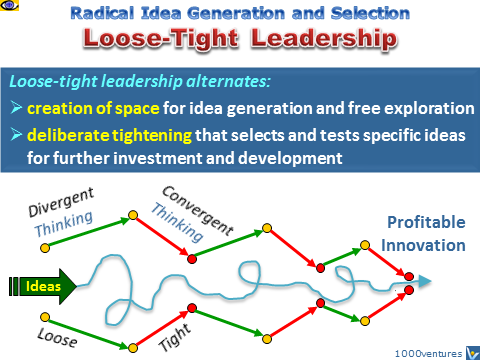
Innovation Process: Diversion
and Conversion of Ideas...
New Challenge:
Leading
Knowledge Workers...
Leadership
Style...
Positioning
of a Leader...
Emotional Task
of the Leader...
Creative
Leadership...
Managing
Creativity...
Creative
Problem Solving (CPS)...
Inspiring
People...
Energizing
Employees...
Volatility Leadership...
Strategic Achievement...
Infecting Your
Firm with the Growth Attitude...
Ten Tips for Maintaining a Fresh
Perspective with Your Employees...
Thought Provokers...
Case in Point
Quantum...
Case in Point
Silicon
Valley Firms...
Case in Point
Hewlett-Packard...
Case in Point
GE...
|