Sustainable Growth:

Performance Measurement System

360-Degree Assessment

Multi-rater Assessment by Supervisors, Peers, Subordinates, and Customers

By: Vadim Kotelnikov

Founder, Ten3 Business e-Coach – Inspiration and Innovation Unlimited


360-Degree Employee Evaluation

Getting feedback and appraisals from:

  1. Supervisors

  2. Peers

  3. Subordinates

  4. Customers

Two Kinds of 360-Degree Assessments

  1. Personality Assessment: HOW you do things; measures character and personality traits

  2. Competency Assessment: WHAT you do; measures discrete, work-related skills such as planning, organizing, staff development, teamwork, or performance feedback.


Winning Organization

Balanced Organization: 5 Basic Elements

Smart Executive

Leader 360

Leadership Attributes

Business Architect

Using Best Practice: The Trotter Scorecard

Sustainable Growth Strategies

Balanced Business System

6Ws of Corporate Growth

Balanced Scorecard (BSC)


360-Degree Assessment

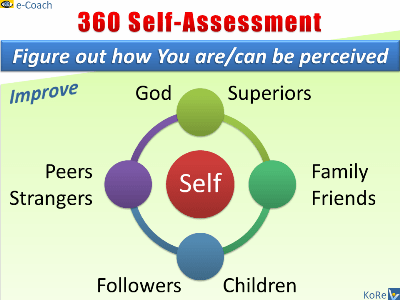
The 360-degree assessments are commonly used in corporations in management and leadership development programs. In 360-degree assessment, the participant completes a self-assessment and also collects feedback from supervisors, peers, subordinates and customers (or sometimes vendors).

Benefits of 360-Degree Assessment

The 360 feedback gives employees a deep understanding of their strengths and areas to develop. The advantage of 360-degree assessments is that you are able to compare your self-perceptions with feedback that shows how others – supervisors, peers, subordinates and customers – perceive you. Studies show that work performance improves when people receive 360-degree assessment feedback, and learning-type individuals who have the greatest skill or personality deficits benefit the most.

Community Feedback – a Simplified Version of 360 Feedback

"Community feedback" is a simplified version of 360 evaluation and feedback in which a small group of three to five people are selected by the manager and the employee to provide feedback.


Bibliography:

  1. "The Centerless Corporation," Bruce A.Pasternack and Albert. J. Viscio

  2. "The Achievement Paradox," Ronald A. Warren


Map

Ranked #1

Search

Glossary

Free Downloads

  Products

Testimonials

Training

 Contact

We invented Business e-Coaching in 2001

Today, we have customers in 100+ countries!

Our customers:

3M, ABB, Adidas, Alcatel, American Express, Bayer, Boeing, British American Tobacco, BP, Canon, Cisco, Citigroup, Colgate, Corning, Deloitte, Ernst & Young, Fujitsu-Siemens, GE, Goldman Sachs, HP, Hitachi, Huyndai, IBM, Intel, Johnson & Johnson, JP Morgan Chase, KPMG, Lufthansa, Microsoft, Motorola, Nokia, Oracle, Renault, Samsung, Shell, Siemens, Sony, United Bank of Switzerland

Ten3 Mini-courses: SMART & FAST sets Full version of Ten3 Business e-Coach Ten3 Business e-Coach (home page)

Ten3 Business e-Coach

Inventor, Author & Founder – Vadim Kotelnikov

© Vadim Kotelnikov, GIVIS