Business Models:

Value Chain Management

Virtual Integration

New Approach to Value Chain Management in the Digital Economy

By Vadim Kotelnikov, Founder, Ten3 BUSINESS e-COACH – Innovation Unlimited!, 1000ventures.com

"You've got to think about 'big things' while you are doing small things, so that all the small things go in the right direction." Alvin Toffler

Virtual Integration: Action Areas

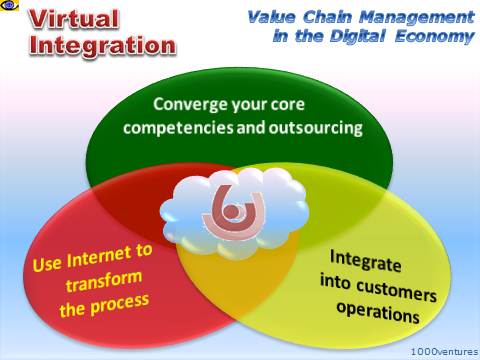
  1. Integrate into customers' operations. To increase customer value-added and differentiate yourself from your competitors, integrate yourself into your customers operations. The more of your customers' work you undertake, the harder it is to find the line that separates you from them.

  2. Use Internet to transform the processes that link you with your customers, suppliers and other alliances and work intimately with them to reduce distinctions from them.

  3. Converge your core competences and outsourcing. With virtual integration, flawless coordination of outsourced processes, such as product design or coaching, can be achieved so that operations of different companies are intertwined and cannot exist independently.

Extended Enterprise Core Competencies Virtual Integration Strategic Alliances Outsourcing Customer Partnership

Vertical vs. Virtual Integration

  • Vertical integration performs

  • Virtual integration innovates


 Discover much more!

Business Model

New Business Models

8 Best Practices of Successful Companies

Business Processes

Enterprise-wide Business Process Management (EBPM)

8 Essential Principles of EBPM

4 Phases of IT/Business Alignment

10 Commandments of Improvement

Using Best Practice: The Trotter Scorecard

Lean Production

7 Principles of Toyota Production System (TPS)

5 Elements of Enabling a Lean Approach

9 Waste Categories and 6 Guidelines of the Canon's Suggestion System

Quality Management

Deming's 14 Point Plan for Total Quality Management (TQM)

  Ten3 Mini-Courses   Presentation:    View    Download

Synergizing Value Chain  (200 slides)


What Is Virtual Integration?


Virtual integration is a new form of value chain management. Under such a system, the links of the value chain are brought together by informal arrangements among suppliers and customers. Shipments of the components that your firm needs can be easily arranged through the Internet or a networked computer system. The same type of arrangement allows you to fully serve your customers in ordering, services, or any other needs.

Why Virtual Integration?

Today the vision for many manufacturers is to become virtual companies, owning only the brand and the customer. The design, system development, product sourcing, logistics, and even final assembly can all be outsourced to supply chain partners. Increasingly the goal is to replace physical assets with information in such a way that every member of this extended supply chain benefits. This forces the move from an environment of ‘hard wired integration’, where relationships are arms-length and adversarial, even across functional boundaries within the organization, to an environment based on ‘negotiated sourcing’, where non-core activities are outsourced and collaborative partnerships are the norm.2

Virtual versus Vertical Integration

Vertical integration is history, the future will be about virtual organizations operating within virtual supply chains. Virtual integration, as opposed to traditional vertical "contractor-subcontractor" integration, represents the decomposition of the traditional company. Virtual integration is characterized by culturally different value-added relationships between manufacturers and suppliers. In the new world of virtual integration, no matter who signs the check, all the people are working together for a common cause. Vertical integration performs, virtual integration innovates.

Integrating E-business

Business processes must not only incorporate timely company information – for improved customer relationship management, supply chain management, and beyond, they must also be kept up-to-date with fast-changing business needs. E-business facilitating these processes is the way most business soon will be transacted. Whether or not you ever plan to sell products or services over the Web, your most important customer or supplier may one day insist upon using Web for all transaction.

The fastest growing companies are moving aggressively to bring e-business into all their operations. They align their systems with their fast-changing business priorities and use these systems strategically, for growth. In addition, successful businesses are employing information technology to gather and interpret data about their ultimate customers, including demographics, trends, and buying behavior.

 Case in Point  Dell Computer Corporation

When Dell Inc. first began using the Internet to expand their business, the company had three basic objectives:

  1. to make it easier to do business with Dell,

  2. to reduce the cost of doing business with Dell, and

  3. to enhance their customer relationships.


Starting in 1996, by 1999 Dell was selling more than $35 million per day over the Internet. "But for Dell, online commerce was only the beginning," writes Michael Dell1, the Founder & CEO of Dell Computer Corporation. "Because we viewed the Internet as a central part of our IT strategy, we started to view the ownership of information differently, too. Rather than closely guarding our information databases, which took us years to develop, we used Internet browsers to essentially give that same information to our customers and suppliers – bringing them literally inside our business. This became the key to what I call a virtually integrated organization – an organization linked not by physical assets, but by information. By using the Internet to speed information from between companies, essentially eliminating inter-company boundaries, it would be possible to achieve precision and speed-to-market for products and services in ways not dreamed possible before. It would be the ultimate business system for a digital economy."1

Cymruco Inventory Manager is a new, easy to use inventory control program.

It is an ideal tool for any company, large or small, which doesn't wish to operate a complex, oversized, MRP system when all they really want is the ability to manage inventory, vendors, customers and associated purchase orders, sales orders and invoicing.


Bibliography:

  1. "Direct from Dell", Michael Dell with Catherine Fredman

  2. "From vertical integration to virtual integration; Barriers to infomation flows and how to overcome them," Jeremy Hammant


Map

Ranked #1

Search

Testimonials

Free Downloads

  Products

SMART Learning

Training

 Contact

We invented Business e-Coaching in 2001

Today, we have customers in 100+ countries!

Our customers:

3M, ABB, Adidas, Alcatel, American Express, Bayer, Boeing, British American Tobacco, BP, Canon, Cisco, Citigroup, Colgate, Corning, Deloitte, Ernst & Young, Fujitsu-Siemens, GE, Goldman Sachs, HP, Hitachi, Huyndai, IBM, Intel, Johnson & Johnson, JP Morgan Chase, KPMG, Lufthansa, Microsoft, Motorola, Nokia, Oracle, Samsung, Shell, Siemens, Sony, United Bank of Switzerland

Ten3 Mini-courses: SMART & FAST sets Full version of Ten3 Business e-Coach Ten3 Business e-Coach (home page)

Ten3 Business e-Coach, version 2008

Inventor, Author & Founder – Vadim Kotelnikov

© Vadim Kotelnikov, GIVIS