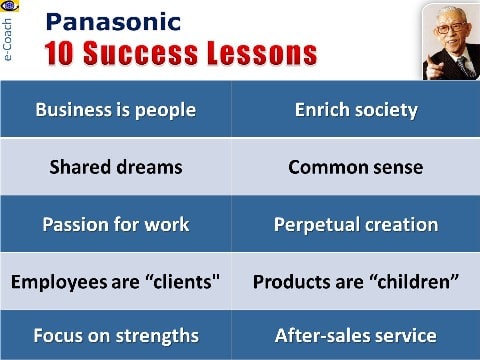
|
Corporate
Management
Follow the Laws of Nature
Obey the laws of nature: this is the very core
of Konosuke Matsushita’s business philosophy. Successful business is
ordinary, normal business, selling at a price that allows a fair margin or
profit, collecting payment on time, and so on. Clever strategies and careful
calculations may be important, but simple universal laws must always be
observed.
The Tao of
Business Success
Management Is Perpetual Creation
For Konosuke Matsushita, business was a
creative activity; it was a process
of producing something valuable out of nothing. You start with an idea for
an enterprise. Then you hammer out a basic plan, raise the necessary
capital, and put together the necessary facilities and equipment. Finally,
you hire employees, develop a line of products, manufacture them, thereby
making a contribution to society. Moreover, each area of management has its
own mode of operation, and anyone hoping to succeed in business must be able
to adapt those modes quickly to the constantly changing social and economic
environment.
Entrepreneurial Leader: 4 Attributes
Don't Assume That Something Is
“Impossible“
"We speak of the shortcomings of the purely
intellectual approach, but this refers to our wariness of half-baked
theories that can prevent us from proceeding to a practical solution,” said
Matsushita. “If necessity is the mother of invention, then simple,
unaffected determination is its father. Even when everyone around you say
it's impossible, if you step back and rethink your task in the simplest
possible terms, free of the noise of over-erudite and preconceived notions,
often the solutions will come to you, out of the blue, so to speak."
Be Different and Make a Difference!
Bad Times Have Their Bright Side
Konosuke Matsushita had an idiosyncratic view
of the meaning of good times. During prosperous times," he would say, "you
move along at a gallop; in times of recession, you saunter at a leisurely
pace. When you're galloping, you haven't got time to look around you, so you
don't notice any problem. But when your pace slackens, you can see
everything in all directions, and if you notice something wrong you have
time to fit it."
More
about Matsushita's 10 Lessons in Corporate
Management
Creating
Customer Value
Put the Customer
First
As he built his company, Konosuke Matsushita
never lost sight of the importance of putting the needs of his customers and
the public first. Panasonic's
vision of the digital future is driven by the
needs and aspirations of its business customers and millions of consumers
around the world who use their products every day. By sharing their
customers’ dream to live a fuller life, Panasonic provides ways of working
smarter and enjoying the rewards of technological advances.
Customer Success 360
Treat Your Products Like Your Children
Konosuke Matsushita had extraordinary
passion
for both manufacturing and the products his company made. "The goods we make
here every day," he would tell his employees, "are like children we raise
with tender care. Selling them is like seeing those children grow up and go
out into the world. It is only natural, then, that we should be concerned
about how they are getting on in their lives, and so go and see for
ourselves." Matsushita believed that maintaining this concern for what you
produce is the first step toward building an ordinary supplier-client
relationship into a stronger link based on mutual trust.
Personnel
Management
People Before Products
Konosuke Matsushita kept saying, “We produce
people, and we also produce electrical goods." He always believed that the
measure of a company was the people who worked for it, that no enterprise
could succeed if its employees did not grow as human beings, and that
business, first and foremost, was about cultivating human potential. No
matter how much capital, technology or equipment an enterprise boasts, it is
bound to fail if its human resources are not developed. And Matsushita did
not mean merely improving employees' technical know-how, management, or
sales skills, though these are certainly part of the concept. For him, the
true aim of personnel development was to cultivate individual self-reliance
and responsibility, to guide employees to an understanding of the value and
significance of their own work and of the obligation of the company to
contribute to society.
People Are Diamonds in The Rough
Right from the very early days of the company,
Konosuke Matsushita put immense effort into personnel training and
development. "However much you rub it," he reflected later, "you can't make
a diamond from an ordinary stone. But if you have a diamond in the rough,
you can draw out its gleam with careful polishing. And depending on how you
polish it and cut it, you can make it sparkle and shine in various different
ways. People are just like uncut diamonds; they each have the potential for
various kinds of brilliance, qualities which, if polished right, will shine
radiantly. It is very important for personnel managers to have a proper
grasp of this concept, and to attempt to draw out the special strengths of
each employee."
Inspiring People
Focus of People’s Strengths
Konosuke Matsushita used to say that, as a
manager, focusing on people's shortcomings quickly gave him a headache. When
you only look at weaknesses, every person you encounter appears inadequate
in one way or another, and you end up vacillating about assigning anyone to
the job or task you have at hand. Subordinates, too, are bound to be unhappy
if all you ever notice is their failings. "I always tried," Matsushita said,
"to notice people's strong points seven times out of 10 and their weaknesses
the remaining three." By paying more attention to employees' strengths, he
believed, he would be more likely to think of ways to put those strengths to
good use. The important thing is to keep your assessment of others'
strengths and weaknesses in proper proportion.
|