|
Contents
1. Innovation as a Key to Success
What Is Innovation?
The Tree of Business
Why Innovation?
New Innovation-driven Economy
See
the slide
Revolution in Innovation: 3 Stages
Balanced Business System
Sustainable Innovation – the Key to
Survival and Success
Hard vs. Soft Innovation
Lessons
from Jack Welch:
Constantly Focus of Innovation
Radical vs. Incremental Innovation
Innovation: The Key Players
Business Model: 6 Components
Top 10 Forces Behind New Business
Models
Business
Case: Innovative Business Model of Amazon.com
Competitive Strategies
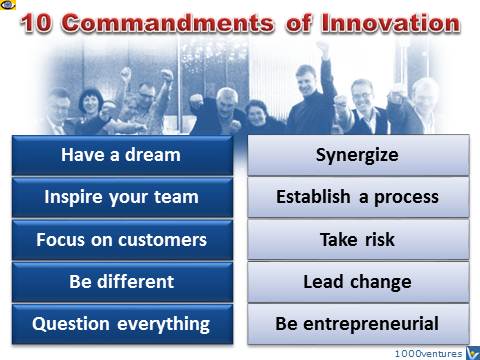
10 Commandments of Innovation
2. Innovation Strategies
Creating Sustainable Profit Growth: 9
Questions to Answer
Business BLISS
Strategic Intent
Lessons
from Jack Welch:
Stretch!
See
the slide
Shift from Linear to Systemic
Innovation
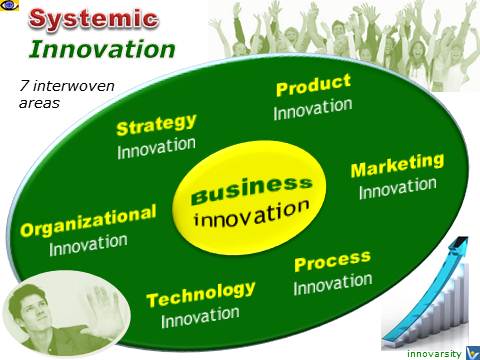
Systemic Approach to Innovation: 7
Interwoven Areas
The Scientific Method as a Model for
Discovery
Strategy Innovation: 4 Steps
Business Innovation and Growth
Strategies
Lessons
from Jack Welch: See Change as an Opportunity
Best
Practices: Characteristics of the Most Successful
Companies
Technology Innovation: 4 Types
Product Innovation: New Product Types
Innovation Strategy: Road-mapping
Venture Strategies: Internal and
External Ventures
Venture Management vs. Corporate
Management
5 Critical Success Factors for New
Ventures
Success
Story:
In-company Ventures by Corning
Specific Skills of Radical Project
Managers
Success
Story: Corporate Venture Investing by GE Equity
Best
Practices:
GE Equity – Critical Success Factors
Process Innovation: Shift to
Cross-functional Paradigm
The Tao of Business Process Innovation
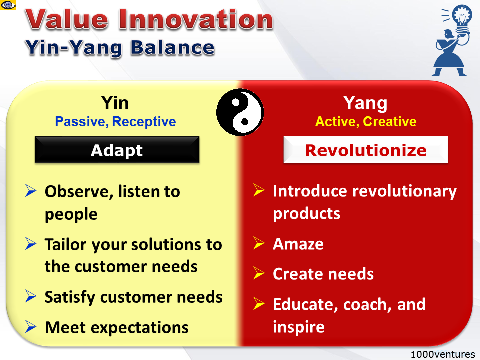
The Tao of Value Innovation
Customer-driven Innovation: 7 Practice
Tips
Mutual Creativity in Business
Partnerships
Customer Partnership: Involving
Customers as Co-innovators
Strategic Achievement
3. Innovative Organization
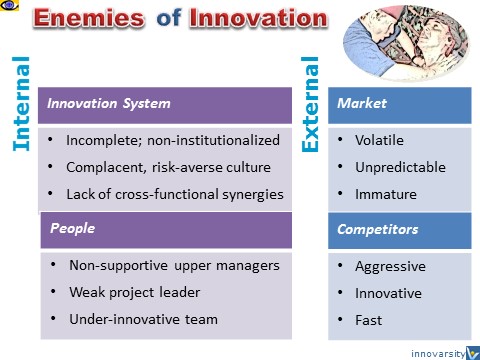
Top 6 Barriers To Innovation Success
How To Prevent Innovation: 10 Humorous
Tips
Innovation-friendly Organization: 6
Components
Lessons
from Procter & Gamble: Making Innovation the Norm
Creating a Culture for Innovation
Best
Practices:
Google's Nine Notions of Innovation
Inspiring People
See
the slide
Creating a Culture of Questioning: 5
Strategies
Creative
Chaos Environment
The Fun Factor
Best Practices:
Hackathon at JotSpot
Lessons
from Jack Welch: Get Good Ideas from Anywhere
Harnessing the Power of Diversity
The Tao of Leveraging Diversity
Creating Cross-functional Teams
The Tao of Intellectual
Cross-pollination
Facilitating Cross-pollination of Ideas
Fast Company
Success
Story:
Charles Schwab
Best
Practices: Charles Schwab's Corporate Guiding
Principles
Launching a Crusade
Lessons
from Jack Welch: Get Rid of Bureaucracy
Building a Coaching Culture
Owning Your Competitive Advantage
Lessons
from Jack Welch: Create a Learning Culture
The Wheel of Knowledge Management
Best
Practices: 4 Strategies for Raising Corporate IQ at
Microsoft
Engaging Cross-functional Innovation
Teams
Best
Practices:
Cross-functional Innovation Teams at Quantum
Managing Knowledge Workers
Best
Practices: Google's 10 Golden Rules
Capturing and Shaping Ideas
The Tao of Effective Brainstorming
Perfect Brainstorming: 10 Rules
Best
Practices: Utilizing Intellectual Property by
Technology Businesses
Intellectual Property Management
4.
Innovation
Processes
Managing Innovation vs. Managing
Operations
Best
Practices:
Attributes of Effective Innovation in Silicon Valley
Innovation Process: Traditional
Phase-Gate Model
Innovation Process: Flexible Model
Business Synergies Approach to
Innovation Project Management
The Jazz
of Innovation
The Jazz of Innovation: 11 Practice
Tips
Radical Innovation: Key Uncertainties
Fuzzy Front End
Specific Skills of Radical Project
Managers
Keys to Successful Market Learning
Radical Innovation: A Different Role of
Prototyping
Turning Failures Into Opportunities
New Product Development by
Cross-functional Teams
Leading Systemic Innovation
Lessons
from IDEO: New Product Design
Lessons
from Silicon Valley Companies: Measuring Innovation
Measuring Innovation: New Product
Metrics
5.
Innovative People
Great Innovator: 8 Winning Habits and
Guiding Principles
Innovation Is Love
Innovation Drivers in Industrial and
Knowledge Enterprises
Innovation Leader: Cross-functional
Excellence
Creating a Relentless Growth Attitude
Entrepreneurial Leader: 10 Key Action
Roles
Building a Team Culture
A Dream Team: 7 Characteristics
Team Assessment
Creative Leadership
Entrepreneurial Creativity: Action
Areas
Developing Entrepreneurial Creativity
6 Barriers
To Creative Thinking
Creativity: 3 Intertwined Pillars
See
the slide
Asking Searching Questions
Disney
Creativity Strategy
Accidental Discoveries
Inventing
New Products: Selected TRIZ Principles
Do's and Don'ts of a Successful
Innovator
Entrepreneurial Creativity: 4
Intertwined Pillars
The Tao of Entrepreneurial Creativity
Build Success from Failures
Problem Solving Strategies: 4 Levels
Creative Problem Solving (CPS):
Reframing
Turn Problems Into Opportunities
Tips for Making the Vision a Reality |
Sample Ten3 SMART Lessons
(Slide + Executive Summary)

Two Components of
Sustainable Growth Strategy
Sustainable business growth
strategy is a practical approach to achieving top-line growth
and bottom-line results. The two main sources of sustainable
competitive advantage are:
-
Continuous Improvement
Culture: continuous effort to improve organizational
climate and productivity of the core business in response to
continuous changes in the marketplace.
-
Durable Corporate Venture
Strategy: internal investment in innovation and new
product/service development, new business creation, and
external venture investing in new technologies and emerging
markets.
Improvement
Strategies versus Venture Strategies
-
Improving Processes:
Addressing the ever-changing needs of current customers and
keeping cash flow healthy. Cost-cutting efforts can build
your bottom line.
-
Radical Innovation:
It is radical innovation and new game changing breakthroughs
that will launch your company into new markets, make you a
market leader, enable rapid growth, and create high return
on investment.
Continuous Change
as a Norm
Companies, like any living
organism, must become learning organizations that change and
adapt to suit their changing environment. “If you don't practice
the change management that looks after the future, the future
will not look after you,” says Bill Gates. "The tendency for
successful companies to fail to innovate is just that: a
tendency. If you're too focused on your current business, it's
hard to look ahead.“
Two Types of
Change in the Marketplace
1. Organic, or continuous, change
2. Radical, or discontinuous, change driven by radical
innovation

New Systemic
Approach to Innovation
Until recently innovation has been
seen principally as the means to turn research results into
commercially successful products, but not all research leads to
innovation and not all innovation is research-based. Certainly
research is a major contributor to innovation, generating a flow
of technical ideas and continually renewing the pool of
technical skills. It should be a vital ingredient in your
enterprise strategy, particularly over long term, if you are to
maintain a stream of competitive products on the market.
Important though research is as the
source of invention, innovation encompasses more than the
successful application of research results. Innovation can also
stem from adopting new technologies or processes from other
fields, or from new ways of doing business, or from new ways of
marketing products and services. The evolution of the innovation
concept – from the linear model having R&D as the starting point
to the systemic model in which innovation arises from complex
interactions between individuals, organizations and their
operating environments – demonstrates that your innovation
policies and practices must extend their focus beyond the link
with research.
Hard vs. Soft
Innovation
-
Hard Innovation is organized
R&D characterized by strategic investment in innovation, be
it high-risk-high-return radical innovation or
low-risk-low-return incremental innovation.
-
Soft Innovation is the clever,
insightful, useful ideas that just anyone in the
organization can think up.
Case in Point:
Lessons from Jack Welch
At General Electric (GE), the sum
is greater than its parts as both business and people diversity
is utilized synergistically in a most effective way. "Practice
systems thinking and holistic approaches," advised Jack Welch.
Seek to improve and optimize the totality of your business
rather than the profits of its components. "Everything about
this enterprise is doing more with less. It needs rejuvenation
all the time. Quality is the next in the learning process.
Getting rid of layer. Getting rid of fat. Involving everyone.
All that was to get more ideas. The whole thing here is to
create a learning organization."
|