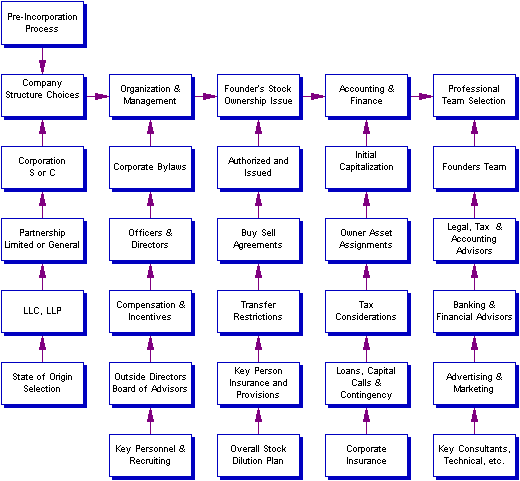
Venture Financing:

Step-by-step Guide

Venture Planning

Chart, Definitions and Concepts

© Venture Planning Associates. Reproduced by permission.

What Is Venture Planning?

  1. Venture Planning is a personal assessment of your feelings and the feasibility of a venture.

  2. Venture Planning answers the question, should I be doing this and why?

  3. The Venture Feasibility process examines seven key factors in any venture.

    1. The Founders' Compelling Interest:  The force that drives you.

    2. Customer Opportunities based on customer wants and needs.

    3. Customer Profiles defines the target market and potential customers

    4. Venture Concepts evaluates alternatives to filling those needs.

    5. Financial Resources identifies and evaluates the financial resources need to pursue alternative venture models.

    6. Entrepreneurial Assessment to find out if the entrepreneur and the venture are in alignment with respect to goals rewards, compelling interests and the ventures mission.

    7. Final venture evaluation of feasibility and comparison of alternatives.

  4. What Venture Planning is not?  It is not about writing a Business Plan.  Sometimes a business plan is not needed.

  5. Venture Planning does not require detailed funding source analysis, professional opinions, entity formation or detailed market analysis.

  1. Venture Planning is development of a means of comparing various business models, usually through financial modeling to answer the following questions:

     
    1. Which venture concept produces the most sales, the best margins, the highest net profit and the lowest breakeven?

    2. Which model requires the least investment by entrepreneurs and others?

    3. Which concept requires equity as opposed to debt financing?

    4. Which produces the highest "Return on Investment" and the best liquidity?

    5. Which model requires the entrepreneur to give up the least equity?        

    6. Identify and quantify the risks involved with execution of each model.

  2. Venture Formation involves all of the following stages:

Idea  - Concept Development - Venture Development - Monitoring Progress - Initiating New Changes - Venture Feasibility Analysis - Business or Operational Plan - Budget vs. Actual - New Plans.

  1. There are four keys to good venture planning:

    1. Focus on one venture at a time in one business area at a time.

       
    2. Discover the opportunity first, and then evaluate how to exploit it.

    3. Develop three cases good, bad & likely for each scenario of a venture concept.

    4. Identify what type of venture you want.  Each type has an entirely different model, implementation and end result.  Each demands a different entrepreneurial approach and each requires different management and style.  Do you want:
  1. a Lifestyle Business with $1 million in annual sales, 1-4 employees and a solo operation?

  2. a Smaller High Profit Business with $1-$20 million in sales, 5 - 50 employees, where partners are required?, or

  3. a High Growth Business with $20-50 million or more in sales with more than 50 employees, that requires venture capital, investment banks and a public company?

  1. There Are 11 Keys To a Good First Venture

  1. Founder's alignment with the mission.  Do you have the attitude and skills to do it?

  2. Guaranteed or qualified customers.  Can you get pre-orders or buy-in by a major client?

  3. Lifestyle of High Profit smaller business.  It is best to get your feet wet here first.

  4. Routine concept:  Is there a currently successful model already in operation?

  5. Available product.  Is the product available, or do you have to develop it?

  6. Advantageous Cash Flow.  Can you run positive cash flow right away? Bragging about “Burn Rates” is a thing of the past

     
  7. Supportive local environment.  Don't try to put a power plant in the high rent district.

  8. Neutral State and Federal Environment.  Can you avoid environmental impact studies and restrictive and time-consuming legal and public relations battles?

  9. Equity Control.  Will you have control and can you maintain control?

  10. Relevant Experience, do you have it now?

  11. Low Overhead.  What is the least you can spend on infrastructure and turn a profit?

  1. What To Do After the Feasibility Study of Numerous Concepts

    1. Pick three of the best with the "snap" of customer needs and pick the least costly concept.

    2. Decide to go or not.  If you decide to go forward, do a detailed business plan or operational plan and then start.

 Discover much more!

Venture Financing

Venture Funding Stages

Venture Funding Round Chart

Step-by-Step Guide to Obtaining Venture Capital

What Are the Venture Capitalists' Investment Criteria?

Guidelines for Presenting High-growth Companies to Investors

Startup Business Plan

Business Planning Chart

How Investors Read a Business Plan

Business Plan DOs and DON'Ts

  Ten3 Mini-Courses   Presentation:    View    Download

Venturepreneur  (100 slides)

Venture Financing  (40 slides)

Venture Financing

Complete "A to Z" Smart & Fast guide

Make your business attractive to investors!

Understand the Venture Financing Chain

Understand the requirements of Venture Capital Investors

Follow unique Step-by-step Guide to Venture Financing

New-generation e-book + 40 slides 


Map

Ranked #1

Search

Testimonials

Free Downloads

  Products

SMART Learning

Training

 Contact

We invented Business e-Coaching in 2001

Today, we have customers in 100+ countries!

Our customers:

3M, ABB, Adidas, Alcatel, American Express, Bayer, Boeing, British American Tobacco, BP, Canon, Cisco, Citigroup, Colgate, Corning, Deloitte, Ernst & Young, Fujitsu-Siemens, GE, Goldman Sachs, HP, Hitachi, Huyndai, IBM, Intel, Johnson & Johnson, JP Morgan Chase, KPMG, Lufthansa, Microsoft, Motorola, Nokia, Oracle, Samsung, Shell, Siemens, Sony, United Bank of Switzerland

Ten3 Mini-courses: SMART & FAST sets Full version of Ten3 Business e-Coach Ten3 Business e-Coach (home page)

Ten3 Business e-Coach, version 2008

Inventor, Author & Founder – Vadim Kotelnikov

© Vadim Kotelnikov, GIVIS