|
Each phase of business or
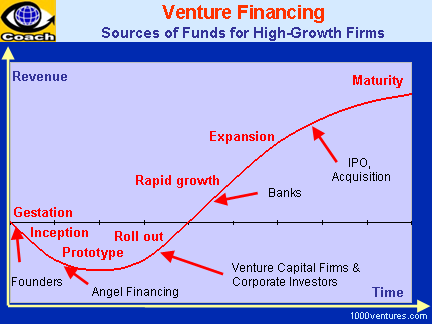
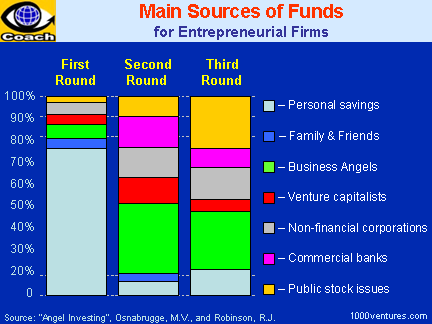
project development has different capital requirements. While most companies do
not seek outside financing at every stage in their growth, early-stage
financing, expansion financing, and acquisition/buyout financing exist for all
stages.
Besides indicating the type
of investment they prefer, you will find that many Venture Capital firms also
specify the stage of financing needed. In general, the later the stage of the
company, the smaller the risk for the Venture Capital firm. Therefore, Venture
Capital firms that invest in later-stage companies must pay a higher valuation
for their equity positions. Typically, venture capital firms expect to achieve a
return on their investment in start-ups within four to seven years, and, in
established companies, within two to four years.
EARLY-STAGE FINANCING
Early-stage financing is an initial infusion
of capital provided to entrepreneurs with little more than a concept. These
funds are used to conduct both market research and product development. Once
research and development are underway, and the core management team is in place,
start-up financing can be obtained to recruit a quality management team, to buy
additional equipment, and to begin a marketing campaign.
First-stage financing enables a company to
initiate a full-scale manufacturing and sales process to launch the product in
the market.
SEED CAPITAL FUNDS
Seed capital funds invest in the earliest
stage companies, and generally expect to have only about 20% succeed to a second
round of financing. This second round will usually be a hand-off to another
fund, or syndication of funds, that now takes the lead on this investment. As a
result, a Seed Capital Fund will almost always demand a very high percentage of
the business, do stage investments with
milestones, and insist upon proactive directors and officers of its choice.
EXPANSION FINANCING
Second-stage financing facilitates the
expansion of companies that are already selling product. At this stage, a
company may raise between $1 to $10 million to recruit more members to the
sales, marketing, and engineering teams. Because many of these companies are not
yet profitable, they often use the capital infusion to cover their negative cash
flow.
Third-stage or
mezzanine financing, if necessary, enables major expansion of the
company, including plant expansion, additional marketing, and the development of
additional product(s). At the time of this round, the company is usually at
break-even or profitable.
IPO (INITIAL PUBLIC OFFERING)
The final step for a successful company is going public, referred to as
Initial Public Offering, or
IPO.
Once a company
goes public, the Venture Capital firm realizes a great deal of value from its
initial investment. For example, if, over the course of several rounds of
financing, the Venture Capital firm has bought 40% of a company for $6 million,
and if the company achieves a public market capitalization of $150 million, then
the value of the Venture Capital firm's investment has grown to $60 million.
This provides the firm with a tenfold return on its investment.
ACQUISITION AND BUYOUT FINANCING ACQUISITION
Acquisition
financing provides the necessary
funds to acquire Another company. Management/leveraged buyout financing assists
management's purchase of a product line or business from another public or
private company. In buyout situations, a key area of consideration for the
Venture Capital firm is its confidence in the management team's ability to
assimilate the assets of the two merging entities.
EXIT THROUGH BEING ACQUIRED
For many venture backed companies that do not look like a 'home run' or do not
look able to sustain their advantage on their own, they become the merger
candidate. There are many advantages to this exit strategy that are not
immediately obvious.
First, running a public versus a private company is completely different. You
may not be prepared for the changes necessary and may need to be replaced by a
new management team.
Second, there can be significant advantages and cost savings by doing a stock
swap with an already public company. Tax savings, liquidity and handing off the
burden of continued fund raising are just a few.
|