|
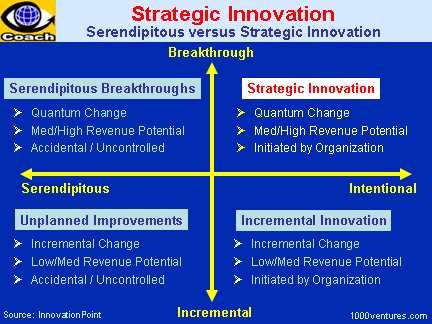
Serendipitous vs.
Strategic Innovation
Many organizations reply on
serendipitous acts
of creativity to foster innovation.
Others take an ad hoc unstructured approach, which often results in
uninspired
incremental improvements or poor implementation.
Strategic innovation is a holistic systematic
approach focused on generating beyond incremental,
breakthrough
or discontinuous innovations. Innovation becomes "strategic" when it is an
intentional repeatable process that creates a significant difference in
the value delivered to consumers, customers, partners and the
corporation. A Strategic Innovation initiative generates a portfolio of
breakthrough business growth opportunities using a
disciplined yet
creative process.
A Holistic,
Multidisciplinary Framework
A
holistic, multidisciplinary framework enables
organizations to take a
strategic approach to innovation.
The framework combines non-traditional,
creative approaches to
business innovation with conventional
strategy development models. It
brings together perspectives from several disciplines: the non-traditional
approaches to innovation found in the business creativity movement;
traditional strategy consulting; the
new product development
perspective of industrial design firms; qualitative consumer/customer
research; futures research found in think tanks and traditional scenario
planning; and organizational development (OD) practices that examine the
effectiveness of an
organization’s culture,
processes and structures.
The framework consists of a cohesive set of
practices that inspire imaginative teams to
look beyond the obvious, explore a broad range of possibilities,
identify significant opportunities, make informed decisions about the
most promising paths to pursue, create a
shared vision for growth, define pragmatic action plans that “bridge
from the future back to the present” and align the organization around the
requirements for success.
Strategic Innovation takes the road less
traveled – it challenges an organization to look beyond its established
business boundaries and mental models and to participate in an open-minded,
creative exploration of the realm of possibilities.
Some organizations may feel that seeking
breakthroughs
is too grandiose a goal, and that they would be content with “simply growing
the business”. Experience shows, however, that focusing on the short-term
typically yields only short-term results – while teams aspiring to seek
significant breakthroughs will both identify “big ideas” and also generate
closer-in, incremental ideas.
Strategic Innovation is not characterized by
mundane, incremental product extensions, the “me-too” business models of
close followers, or band-aids for inefficient processes.
It does not consist
of simple “facilitated creativity sessions and brainstorming
new ideas”. It is not based on the linear principles of traditional
strategic planning
which extrapolate the past in an attempt to predict the future. It does not
result in “pure blue sky”.
Instead, it spans a journey of inquiry and
activity – from creative inspiration at the ambiguous “fuzzy
front end” through the detailed requirements of successful execution
that lead to business impact.
Strategic Innovation calls for a holistic
approach that operates on multiple levels. First, it blends non-traditional
and traditional approaches to business strategy,
deploying the practices of “Industry Foresight”, “Consumer/Customer Insight”
and “Strategic Alignment” as a foundation, and supplementing them with
conventional consulting models.
Second, it combines two seemingly
paradoxical mindsets: expansive, visionary thinking that imaginatively
explores long-term possibilities; and pragmatic, down-to-earth
implementation activities that lead to short-term, measurable business
impact.
|