|
Two Groups of Activities in
any Workplace |
-
Ongoing Operations
the work performed over and over; produce similar products and
have no defined end
-
Projects
all the work that is done one time; have a beginning and an
end; produce a unique product
|
|
Four Project Categories |
-
New
product, service or facility development produce
something new in the organization.
-
Internal
involve infrastructure development, reengineering an organization,
and other improvement that is internal to the organization.
-
External
involve new
product/service development as an external venture, geographical
expansion (e.g. developing strategic alliances, joint ventures,
networks), or organizing of large events
-
Client engagement
are conducted for an external client or customer.
|
|
Project vs Business
Processes |
|
Project |
Business Process |
-
Temporary: has a beginning
and an end
|
-
Ongoing: the process is
repeated over and over again
|
-
Produces a unique output or
deliverable
|
-
Produces the same output
each time the process is run
|
-
Has no predefined work
assignments
|
-
Has predefined work
assignments
|
|
Two Types of Projects and
Project Management Approaches |
|
Project Type |
Management Approach |
|
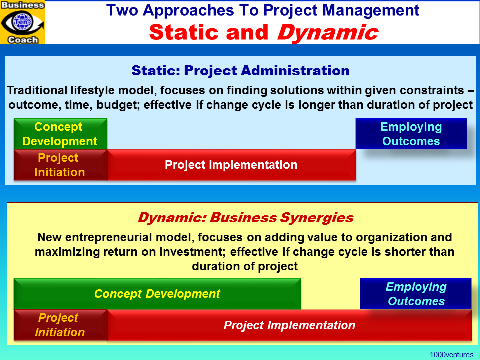
Lifestyle Projects
developing new or improving existing products, services or
infrastructures in a lifestyle business environment |
Project
Administration classic approach built on the triple
constraints of project management - cost, duration, and outcome |
|
Venture Projects
developing new products/services for rapidly changing and highly
competitive markets |
Business Synergies new entrepreneurial approach to managing
projects; goes beyond the triple constraints to consider project and
project outcome lifecycle in a wider context of the overall
organizational strategy |
|
Four Phases of a Project |
-
Initiation
-
Business case analysis,
project charter, and project strategic alignment is completed by the
upper management or sponsor
-
Broad direction for the
project is provided to the
project leader by the
sponsor. Objectives, limits, project priorities, and constraints are
defined.
Outputs:
Business Case
and
Project Charter
-
Planning
-
Define
project stakeholders
-
Select the team members
-
Define
the scope of the project
-
Plan
phases and milestones of the project
-
Define
any
risks
associated with the project and develop ways to prevent them
-
Determine the resources
required to complete the project
Output:
Project Plan
-
Execution
Phase
Output:
Status Reports; Final Deliverable(s)
-
Close-Out
Phase
Output:
Close-Out Report |
|
What is a Project?
Unlike repetitive business
processes or ongoing operations, projects are defined as work that happens
one time only. Each project produces some unique outcome and has both a
clear beginning and an end.
What is Project Management?
Project management is the
planning, organization, monitoring and control of all aspects of a project
and the motivation of all involved to achieve the project objectives safely
and within agreed time, cost and performance criteria. It is a set of tools,
techniques, and knowledge that, when applied, helps you produce better
results for your project. It contains the total amount of
leadership skills, leadership tasks, leadership organization, leadership
techniques and leadership measures for the performance of the project.
The Five Factors that Make a
Project Successful
By: Eric Verzuh, the author of
The Fast Forward MBA in Project Management
To be successful, a project must
have4:
-
Agreement
among the project stakeholders the team, customer, and management
on the goals of the project...
More
GREAT Model
By: Michael S. Dobson
To make your project team function
effectively, the first thing you need to know is the GREAT model:
Goals; Results;
Expectations / Performance;
Accountabilities / Abilities;
Timing.
The GREAT model specifies what people must know before they can work
together effectively...
More
Three Functions, Related Activities and Outputs
Project Definition
Activities: to determine the purpose, goals, scope, outcomes, and
constraints of the project; to identify
stakeholders, their contribution and needs; to establish basic project
management controls
Outputs: charter;
statement of work;
responsibility matrix;
communication plan
Project Planning
Activities: to estimate resource requirements; to make detailed scheduling;
to create risk profiles; to develop procedures for
risk and change
management; to build the project team
Outputs: task list; network diagram, schedule; budget; resource plan; risk
profiles, risk log, risk management plan; change request form; change
management plan; cost-estimating worksheet
-
Project Control Activities: to lead the project team; to measure progress; to monitor the
project for new risks; to take corrective action; to communicate progress;
to close out the project Outputs: status reports for different audiences; cost-tracking guidelines;
cost and schedule tracking charts; issues log; change request log; changes
to scope, deliverables, responsibilities, communication plan, project
deliverables; final evaluation close-out report
The New Business Synergies
Approach
The
business synergies approach is concerned with discovering possibilities
for adding value to the organization, not with finding solutions within
given constraints.
This approach uses a framework for thinking about
projects based on business concepts such as increasing economic value, or
Economic Value Added (EVA).
The use
of economic value as a
decision criterion indicates a change in the way project success is
determined and points the way toward the future of project management. While
the old criteria of meeting outcome, cost, and schedule constraints will
still be important factors for measuring the project progress, they are
augmented by business factors that are used to measure project success.
The entrepreneurial approach to
project management requires you to manage the project as if it were an
independent business venture. But you must also manage with the larger
organizational system in mind. You need to understand how the elements of
the project affect the business as a whole and how elements of the business
influence the project2. This dynamic new approach to projects
will serve you well whether your project is in a business, a non-profit
organization, or a governmental agency.
Best Practices
Google: 10 Golden Rules
-
Make coordination easy.
Because all members of a team
are within a few feet of one another, it is relatively easy
to coordinate
projects. In addition to physical proximity, each
Googler e-mails a snippet once a week to his work group
describing what he has done in the last week. This gives
everyone an easy way to track what everyone else is up to,
making it much easier to monitor progress and synchronize
work flow...
More
Identifying Project Stakeholders
"Satisfy stakeholders!" is the
project manager's mantra. For successful projects, it's not enough to
deliver on the customer's demand; projects have to meet all stakeholder
expectations. Identifying stakeholders is a primary task because all the
important decisions during the initiation, planning and execution stages of
the project are made by these stakeholders.
The five primary project
stakeholders are the project manager, the project team, the functional
management, the sponsor, and the customer. In a larger sense, anyone
who participates in the project or is impacted by its results is a
stakeholder. Each stakeholder has an essential contribution to make, and all
stakeholder expectations need to be met.
Contribution made by different
people to the project is the principal criteria for identifying
stakeholders...
More
Innovation Project Management: The Jazz of Innovation
The improvisation-driven model for
innovation project
management doesnt discard structure, just as there
is a clear structure to good jazz. In innovation, this structure is created
through
roadmaps, guiding principles,
business processes, systems and organizational
charts. Strategic-planning
and road-mapping processes cannot guarantee brilliant flashes of creative
insight, but they can prepare minds and increase the odds that such flashes
occur in real time. Thus structure, as chords do in jazz, serves as a basis
for improvisation,
experimentations,
discoveries and
innovation...
More
Radical Project
Management
As radical innovation
projects are characterized by higher levels of uncertainties technical,
market, and organizational, patterns of their journey to the
marketplace are unlike those in incremental innovation projects...
More
Turning
Failed Projects Into New Opportunities
To profit from experience you must be open and
willing to learn, even from what some people might consider a
failure. What may seem to be a failure can actually
lead to new opportunities, especially if the knowledge acquired from the
failed projects can be exploited. Effective
learning questions can serve as a starting point for the assimilation of
learning. "Learning questions should focus on both project content and the
project-development process. The trick is to generate double-loop learning:
to learn what works and what does not, and about the assumptions (business
logic) that lie behind why it works or why it does not. During reviews, it
is important not only to digest what is learned, but also either to renew
the commitment and
motivation necessary to keep the project going, or to terminate it."1
|