|
"Entrepreneurial
independence demands space for action and
trust, while independence in
a corporation implies responsibility and control imposed from above.
Entrepreneurial
speed
demands agility,
rapid experimentation, adaptation, and rapid response in
order to be
first to market. Corporate experimentation comprises
analysis, review, sober consideration of facts, and willingness
sacrifice speed for thoroughness.
→
Entrepreneurial paranoia –
competitors are catching up to us
– is overshadowed by an essential
need to build corporate consensus and minimize perceived risk," says
Donald L. Laurie, the author of Venture Catalyst : The Five Strategies
for Explosive Corporate Growth...
More
Specific
Leadership
Attributes
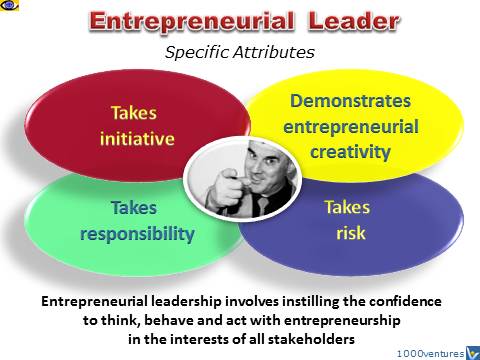
Entrepreneurial leaders
have some specific
leadership attributes. Entrepreneurial leadership is leadership that is based
on the
attitude
that the leader is self-employed. Leaders of this
type:
Steve
Jobs' 12 Rules of Success
18 Leadership Lessons from Colin Powell
-
You don't know what you can get away with until you
try. Good leaders don't wait for official blessing to try out. If you
ask enough people for permission, you inevitably come up against someone who
believes his job is to say "no". So, the moral is, don't ask....
More
Why Change Fails: 8 Errors Leaders Make
Create an Inspiring Vision
Your
vision
statement should be short and inspiring. It must set a challenging
and stretching goal that gives employees enormous freedom in finding
ways to achieve it.
You have also to communicate the message that doing
what you do now, only better, is not enough. If you do what you
always did then you will not even get what you always got as you
have to keep growing to stay where you are. "You have to
do something
different to get different results. You have to do
something significantly smarter
significantly smarter to get significantly better
results."7
Entrepreneurial
Creativity
Entrepreneurial Creativity
is about coming up
with
innovative ideas
and turning them into value-creating profitable
business activities.
Entrepreneurial creativity =
creativity
×
entrepreneurial
action...
More
Leading Innovation
Leading innovation is a delicate and challenging
process. You need to encourage expansive
out-of-the-box thinking to
generate new ideas, but also filter through these ideas to decide
which to commercialize. Use a balanced "loose-tight" style of
leadership for this purpose. "Loose-tight leadership alternates the
creation of space for idea generation and free exploration with a
deliberate tightening that selects and tests specific ideas for
further investment and development."2
Looseness usually
dominates the early stages of the innovation process; in the later
stages, tightening becomes more important to scrutinize the concepts
and bring the selected ones to the market.
A
balanced approach is essential to loose-tight
leadership. Those who remain loose too long generate plenty of ideas
but have difficulty commercializing them. Those who lock into the
tight mode choke off all but most obvious ideas, thus confining
innovation to incremental line extensions of existing products that
add little value...
More
10 Key Project Leader Skills
→
25 Lessons from
Jack Welch
Change and
Leadership...
Transforming Existing
Organizational Structures Into an Entrepreneurial Ecosystem...
Making Quick Decisions...
Discovering and Pursuing
Opportunities...
What Today's Workplace Needs Its
Leaders To Do...
Creative Leadership...
Continuous Rewriting of Leadership
Rules...
Tips for Making the
Vision a Reality...
Leading
Transformational Change...
Making Big Changes...
10 Steps to Develop Entrepreneurial
Staff...
Creating Change...
Leading Change...
Leading Radical Innovation...
Overcoming Resistance to Change...
Rewrite Leadership
Rules Continuously... |