|
|
Some Tips for Successful New Product
Testing
By Paul Sloane2 |
-
Carefully analyze customer reactions and
feedback. Adapt and improve the idea...
More
|
|
|
Turning Ideas into Reality
Prototyping is a fastest way of turning a
concept into reality.
An
→
experimental hands-on try-it-out approach is
invaluable to
→
innovation
 .
You never know the real value of your invention until you test market it.
Rapid prototyping is about building and testing new things fast. It helps
you jump past endless analysis to quickly obtain a valuable
→
feedback. .
You never know the real value of your invention until you test market it.
Rapid prototyping is about building and testing new things fast. It helps
you jump past endless analysis to quickly obtain a valuable
→
feedback.
→
Learning SWOT
Questions
"Before there is a prototype, the ideas exists
in abstract form only,"
writes Paul Sloane,
the author of The Leader's Guide To Lateral Thinking. "It is described in
words and leaves scope for misunderstanding. It is hard for the originator
to convey exactly what he or she has in mind, and it is easy for people to
get hold of the wrong end of the stick. Once the prototype exists then
people can see and touch and feel the idea. Comments for
→
improvement will
flow thick and fast. Whether the prototype is a model in cardboard and
string or a software application consisting of a few skeleton screens with
nothing behind them, it presents a framework for refinement and extension of
the idea."
→
The Jazz of Innovation:
11 Guiding Principles
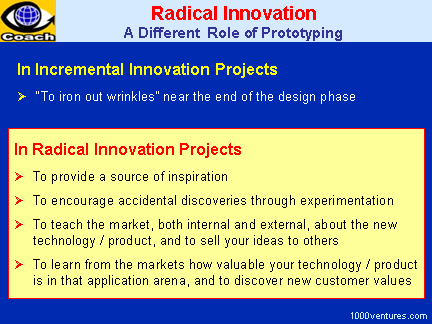
A Source of Inspiration
Once you start making prototypes, you you find
a new source of
→
inspiration
and open up new possibilities of
discovery. You are also likely to encourage accidental discoveries...
More
→
IDEO's
6 Innovation Practice Tips
|
|
 Business
e-Coach Business
e-Coach
 I invented inspirational →
Business e-Coach
in 2001. Today, I have
customers in over 130 countries and
licensed teachers all over the world.
>>>
I invented inspirational →
Business e-Coach
in 2001. Today, I have
customers in over 130 countries and
licensed teachers all over the world.
>>>
→
10 Success Lessons
from Business e-Coach
Though I understand my target market well
enough, I keep launching every new mini-course as a prototype to test the
market. I start with developing and releasing a free micro-course to
analyze the market feedback. I experiment with everything: content, style,
title,
→
differentiation,
→
customer
value proposition,
creative marketing approaches. Having
discovered the optimum combination of ingredients of success, I create and
launch a full-scale show.
>>>
|
 Bloomberg Bloomberg
Michael Bloomberg is an incredible
→
entrepreneur
and a billionaire, and
also a Mayor of New York City. In his book Bloomberg By Bloomberg he
writes, "We made mistakes, of course. Most of them were omissions we didn't
think of when we initially wrote the software. We fixed them by doing it
over and over, again and again. We do the same today. While our
→
competitors
are still sucking their thumbs trying to make the
design perfect, we're
already on prototype version No. 5. By the time our rivals are ready with
wires and screws, we are on version No. 10. It gets back to planning versus
acting. We
→
act from day one; others plan how to plan – for months.'
Discovery
of the
Structure of DNA
Source:
The Art of Innovation,
Tom Kelley
"I decided that no harm could come from
spending a few days building backbone models," said 1963 Nobel Prize winner
James Watson, referring to the metal prototypes he and fellow geneticist
Francis Crick used to model and test their hypotheses. "Perhaps a week of
solid fiddling with the molecular models would be necessary to make us
absolutely sure we had the right answer."
Although their academic colleagues were
skeptical of the approach, Watson and Crick's freethinking style and
openness to two-dimensional and three-dimensional prototyping helped guide
them toward the momentous discovery of the structure of DNA. Even Watson
sometimes wondered if he was floundering. "My doodling of the bases on paper
at first got nowhere. Not until the middle of the next week, however, did a
nontrivial idea emerge. It came while I was drawing the fused rings of
adenine on paper."
|
|
New
Type of Vacuum Cleaner
Source:
The Leader's Guide To Lateral Thinking,
Paul Sloane
James Dyson is an Englishman who invented a new
type of vacuum cleaner involving a 'dual cyclone'. He built over 5000
prototypes as he battled to convince manufacturers and banks to back him.
Eventually he got the backing to develop his
dream and
produce the first production unit. Within two years his machine was the
market leader in the United Kingdom.
|


