 |
|
"Silicon Valley innovators
have uniquely learned how to define, design, and deliver innovation
with a massive degree of flexibility and concurrency."
~ Christopher Meyer,
author of Relentless Growth |
|
| |
|
4
Distinctive Features
of the
Silicon Valley's Economy
①
Growth in the Valley is driven
by innovation
②
The Valley is a knowledge
economy – knowledge work is the
foundation of innovation
③
High competitive intensity – "A
year here is worth seven years
in other industries," say some
executives
④
A combination of a new work
spirit – the Growth Attitude –
and a new approach to innovation
|
|
|
|
|
|
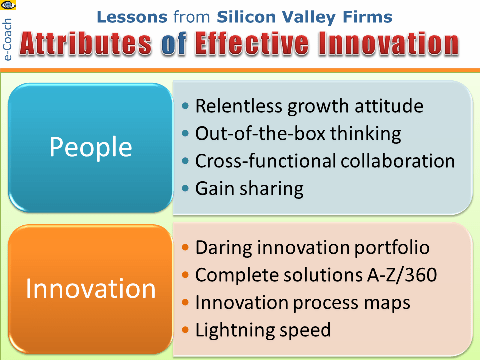
Relentless Growth Attitude
Leaders in the Silicon Valley inject the
Relentless Growth Attitude into the firms.
"This attitude establishes a context within
which corporate executives lead by setting
direction, developing entrepreneurial
strategies, securing resources, defining
organization architecture, and ensuring that
learning occurs."
The
culture of creative dissatisfaction and the
competitive environment in the Valley literally
demands innovation. "Without it, you don't grow
– and in the Valley, if you don't grow, you die.
Relentless growth is a requirement, not a
choice," says Chiristopher Meyer.
Relentless Venturing Attitude
Too
many companies are consumed with what they have
done and where they've been. "In contrast,
Silicon Valley companies are excited about what
they haven't done and where they haven't been."
Failure in the Valley is understood to be an
integral aspect of the growth process.
VC investors,
venturepreneurs, and technologists will
readily abandon a company or technology that
looks unlikely to thrive, using what they have
learned to jump-start the next innovation
effort.
|
|
|
Achievement Attitude
▪
Constructive Competition |
 |
If
you stop
innovating,
you stop creating history and
become history.
~
Vadim
Kotelnikov |
|
Failure
as a
Primary Vehicle for Success
What makes Silicon Valley so
successful as the engine of
high-tech growth is the
Darwinian process of failure.
Noble failures are treated
as a primary vehicle of
innovation and success.
|
|
|
|