| |
|
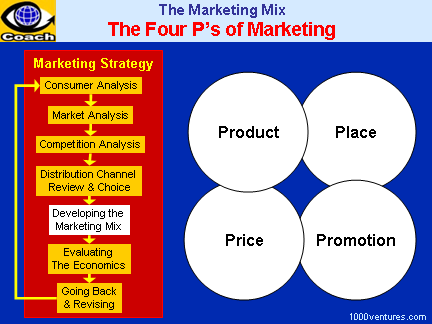
4Ps
of
Marketing Strategy
Product + Pricing + Promotion +
Placement
|
|
|
 |
|
Your
marketing mix (the offering) is a combination of
marketing tools that are used to
satisfy
customers
and company objectives.
Marketing strategies are generally concerned
with four Ps:
product strategies,
pricing
strategies, promotional strategies, and placement (distribution) strategies. |
|
| |
|
The
Four Ps of
Marketing Strategies
|
|
|
|
|
|
Product strategies
Differentiating and positioning
new products
Emphasizing new features and benefits
of existing products, repositioning them, adding new services
Balancing product portfolio
Pricing strategies
Defining the value of the
product to the customer and
pricing in terms of value rather
than cost
Selecting the pricing strategy
(skimming, market penetration, comparable pricing, etc.)
Creating extra benefits (smart
discounting, premium pricing, free services, etc.)
Promotional strategies
Selecting the most effective
marketing strategies (emotional,
digital, experiential,
credibility, public relations,
buzz marketing, etc.) and/or
designing radically new
creative marketing
approaches
Branding, creating customer value
proposition, unique selling proposition (USP),
core marketing message (CMM),
and the public relations brief
Specifying the advertising methods
platform, and media; choosing product placement channels and selecting the
relationships with the producer.
|
|
| |
Placement strategies
Specifying geographic region or industry and how
the environment in which the product is sold in
can affect sales.
Specifying the market segment (teenagers,
adults, families, business people, etc.)
Choosing the distribution channels
(point-of-sale placement, retaining, online
selling, etc.) and deciding the levels of
customer service.
|
|
|
|
|
|
Product
Does
your company create what its targeted customers
want? What does the customer want from the
product/service? What
needs does it satisfy? What features does it
have to meet these needs? How and where will the
customer use it? How is it
differentiated versus your competitors?
Pricing
What
is the value of the product or service to the
buyer? How much are the targeted customers
willing to pay for the product? Is the customer
price sensitive? How will your price compare
with your competitors?
Promotion
How
are the chosen target groups are informed or
educated about the company and its products? How
and when can you get across your marketing
messages to your target market? How do your
competitors do their promotions?
Placement
Where
do buyers look for your product or service? Are
your products available at the right place, at
the right time, in the right quantities? What do
your competitors do, and how can you learn from
that and/or differentiate?
|
|
|
|